Rat In A Maze Problem SolvedJavaScript Backtracking

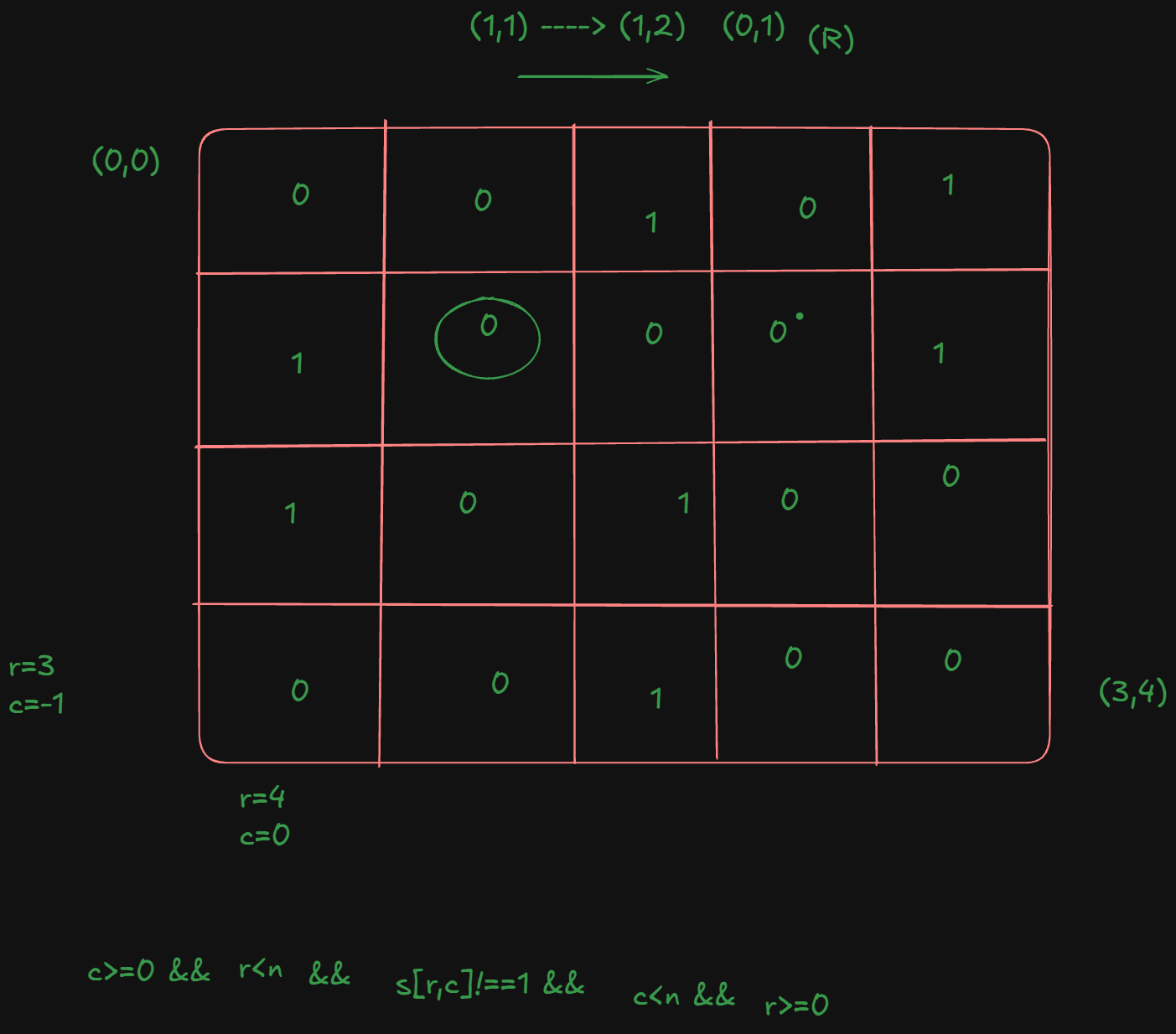
In this article we will solve Rat in a maze problem with backtracking. The rat start point is (0,0) and exit point is (n-1, n-1). The rat can move to 1 and 0 is blocked.
Diagram
Code
class Solution {
    //direction object
     direction = [
         {dir: "D", row:1, col:0},
         {dir: "L", row:0, col:-1},
         {dir: "R", row:0, col:1},
         {dir: "U", row:-1, col:0}
    ]
    isValid(r,c,maze, n){
        if(c>=0 && r>=0 && c<n && r<n && maze[r][c]!==0){
            return true
        }
        return false
    }

    findPath(maze, r,c,path, ans, n){
        //base condition
        if(r==n-1 && c==n-1){
            ans.push(path)
            return
        }
        //mark this cell as visited
        maze[r][c] = 0
        //move all the directions
        let d = this.direction
        for(let item of d){
            let newRow = r+item.row
            let newCol = c+item.col
            if(this.isValid(newRow, newCol, maze, n)){
               path = path + item.dir
               //find the further paths
                this.findPath(maze, newRow, newCol, path, ans, n)
               //backtrack the path
               path = path.slice(0,-1)
            }
        }
        //backtrack the visited cell
        maze[r][c] = 1

    }
    ratInMaze(maze) {
        // code here
        let n = maze.length
        if(maze[0][0]===0 && maze[n-1][n-1]===0){
            return []
        }
        let path = ""
        let ans = []
        let r=0
        let c=0
        this.findPath(maze, r, c, path, ans, n)
        return ans
    }
}
Time Complexity & Space Complexity
At every cell, we try 4 directions:
Down
Left
Right
Up
So from one cell → max 4 recursive calls.
Imagine the maze is:
1 1 1
1 1 1
1 1 1
No blocks at all.
From each cell you can move in up to 4 directions.
So branching factor ≈ 4.
Now how deep can recursion go?
Maximum path length = n × n
(because we cannot revisit cells)
So recursion depth ≤ n².
Worst case time complexity:
O(4(n2))O(4^{(n^2)})O(4(n2))
Why Exponential?
Because:
Each cell → 4 choices
Each next cell → 4 choices
Each next → 4 choices
So:
4×4×4×...(n2times)4 × 4 × 4 × ... (n^2 times)4×4×4×...(n2times)
That becomes:
4n24^{n^2}4n2
But Practically?
We mark visited
So many paths get cut early
Real runtime much smaller
But worst case remains exponential.
Space Complexity
Now let’s calculate space usage.
Recursion Stack
Max depth = number of cells in path
=n2= n^2=n2
So stack space:
O(n2)O(n^2)O(n2)
Answer Array
If there are many valid paths, output itself can be huge.
Worst case number of paths is exponential.
So result storage =
O(number of paths×path length)O(number\ of\ paths × path\ length)O(number of paths×path length)
Worst case also exponential.
Final Answer
Time Complexity
O(4n2)O(4^{n^2})O(4n2)
(Exponential)
Space Complexity
Without counting result:
O(n2)O(n^2)O(n2)
Including result:
O(4n2)O(4^{n^2})O(4n2)
(because output itself may be exponential)


